

On January 3, 2009, Satoshi Nakamoto mined Bitcoin’s genesis block. Seventeen years later, Bitcoin mining powers cryptocurrency and AI infrastructure worldwide.
Bitcoin mining is the process that creates new Bitcoin while verifying and recording transactions on the blockchain. On average, every ten minutes, a miner somewhere in the world earns the right to add the next block of transactions. That block is then added to Bitcoin’s ledger. In return, they receive a reward of 3.125 BTC. Competition for that reward has fueled one of the most intense technological arms races in modern history. What began as a hobby that anyone could run on a laptop has become a capital-intensive industry. Today, the industry depends on specialized chips, low-cost electricity, large data centers, and disciplined financial management.
The history of Bitcoin mining is also the history of Bitcoin’s security. Every miner who invests in hardware, electricity contracts, and data centers is betting that Bitcoin will hold its value long enough to recover those costs and generate a profit. In turn, those investments make Bitcoin’s blockchain expensive to attack. For example, anyone attempting to rewrite Bitcoin’s transaction history would need to control more computing power than every honest miner combined. Today, that would require an investment worth hundreds of billions of dollars. As a result, the mining industry’s scale and financial strength are not just economic stories. They are essential to Bitcoin’s security.
This guide covers the complete history of Bitcoin mining. It covers every major hardware era and geopolitical disruption. It also examines the rise of publicly traded miners, the China ban that changed the industry globally, the 2024 halving’s economic impact, and the AI pivot. Finally, it also complements our Bitcoin history research and Bitcoin halving research as part of this library’s complete Bitcoin coverage.

How Bitcoin Mining Works
Before going through the history, it helps to understand what miners are doing because the process drives almost everything that follows.
Bitcoin uses a consensus mechanism called Proof of Work. To add a new block to the blockchain, a miner must find a specific number called a nonce. When combined with the block’s transaction data and passed through Bitcoin’s SHA-256 hashing algorithm twice, the nonce must produce a hash that starts with a certain number of zeros. Finding that number requires trial and error. Miners test billions of different nonce values every second until one produces a hash that meets the network’s current difficulty requirement.
The difficulty requirement determines how many leading zeros the hash must have. It adjusts automatically every 2,016 blocks, or about every two weeks, to keep the average block time close to ten minutes. If miners collectively find blocks faster than that, the difficulty increases. Conversely, if they find blocks more slowly, the difficulty decreases. As a result, Bitcoin produces about one block every ten minutes over long periods, regardless of how much computing power miners contribute.
How Miners Get Paid
The reward for mining each block has two parts: the block subsidy, currently 3.125 BTC, and the transaction fees paid by users whose transactions are included in the block. The subsidy has fallen four times from the original 50 BTC through Bitcoin’s halving schedule. As documented in our Bitcoin halving research, transaction fees become more important as the subsidy declines. Over time, Bitcoin’s security will depend on whether fee revenue can replace the subsidy lost with each successive halving.
Bitcoin’s SHA-256 algorithm is a one-way function. Given any input, it always produces the same output. However, given only the output, it is computationally infeasible to determine the original input. This property makes Bitcoin’s Proof of Work secure because there is no shortcut to finding the correct nonce. Instead, miners must test billions of combinations every second until one works. More hashing power increases the chance of finding a block, but intelligence or strategy cannot replace computational effort.
The Hardware Eras: Four Generations of Bitcoin Mining Technology
Era 1
CPU Mining: When Anyone Could Mine Bitcoin (2009–2010)
Hash rate: ~4.7 MH/s · Block reward: 50 BTC · Anyone with a computer
Bitcoin mining began in 2009 using ordinary CPUs, with miners earning 50 BTC per block at virtually zero competition. When Satoshi mined the genesis block on January 3, 2009, the entire Bitcoin network consisted of one machine running one CPU. Bitcoin launched with a difficulty of 1, the minimum level. At that difficulty, any modern CPU could find a valid block in seconds.
Satoshi designed Bitcoin with the explicit intention that “one CPU, one vote” would be the basis for participation. The goal was a decentralized system where anyone with a computer could help secure the network. For the first year of Bitcoin’s existence, the network largely reflected that vision. The mining community remained small, committed, and motivated more by ideology than economics. Bitcoin had no market price in early 2009, so the 50 BTC reward for mining a block was worth exactly zero dollars.
Researchers estimate that Satoshi mined about 1.1 million BTC during this early period. Satoshi has never moved those coins, and most researchers consider them permanently inaccessible. Satoshi mined continuously through most of 2009 and into 2010, maintaining about 70% of the network’s total hash rate. As a result, Satoshi secured the network almost single-handedly while few others saw value in Bitcoin. As more miners joined, Satoshi’s share declined. By late 2010, the network had enough distributed participation for Satoshi to step back from mining without compromising security.
Bitcoin Gets a Price
Bitcoin received its first exchange rate in October 2009 at $0.00099 per coin. New Liberty Standard calculated the price based on the electricity cost of mining. The first commercial Bitcoin transaction followed on May 22, 2010, when Laszlo Hanyecz paid 10,000 BTC for two pizzas, as documented in our Bitcoin history research. At the time, Bitcoin traded for about $0.0025. Mining 10,000 BTC required months of CPU work and only a few dollars in electricity.
Era 2
GPU Mining: The First Arms Race (2010–2013)
Hash rate: up to ~2 GH/s per GPU · The hobbyist era ends · Mining pools emerge
The transition from CPU to GPU mining began in 2010 when ArtForz, a programmer in the early Bitcoin community, discovered that graphics processing units could perform SHA-256 hashing far more efficiently than CPUs. GPU mining delivered roughly 100 times the hash rate of CPUs and sparked the first mining arms race. A single high-end GPU in 2010 could produce about 200 megahashes per second, compared with the 4 to 7 MH/s produced by a typical CPU.
ArtForz kept the discovery private for several months. During that time, he mined significant amounts of Bitcoin with a private GPU farm before other miners understood what was happening. Once the technique became public through ArtForz’s disclosure and independent discoveries by other miners, the CPU mining era ended within weeks. CPUs became uncompetitive almost overnight, marking the network’s first hardware obsolescence event.
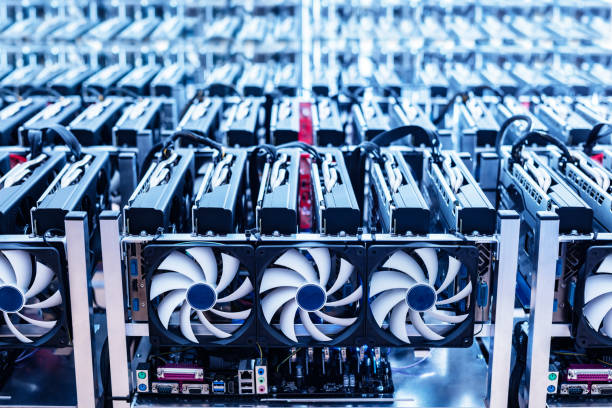
The GPU era democratized mining in one sense because GPUs were consumer products available at retail electronics stores. However, it also concentrated mining in another. Rigs with six, eight, or twelve GPUs consumed far more electricity than a single laptop and required dedicated cooling and space. As a result, mining moved beyond bedroom computers to purpose-built rigs operated by technically skilled individuals with access to suitable infrastructure.
Mining Pools Change the Economics
The GPU era also introduced mining pools, where miners combined their hash rate and shared block rewards in proportion to their contributions. Slush Pool, now Braiins Pool, launched in November 2010 as the first mining pool. It allowed miners to combine their hash rate and receive more consistent payouts. The economic logic was simple. A solo miner with a limited hash rate might go months without finding a block, while pool members receive smaller, more predictable payouts. Mining pools changed mining from a high-variance lottery into a steadier source of revenue. However, they also concentrated coordinating power in the hands of pool operators.
By 2013, GPU mining was already becoming obsolete. The next generation of mining hardware was arriving, and it would make GPU mining as uncompetitive as CPU mining had become just a few years earlier.
Era 3
FPGA Mining: The Brief Bridge (2011–2013)
Field-Programmable Gate Arrays · More efficient than GPUs · Quickly superseded
Field-Programmable Gate Arrays (FPGAs) are chips that can be programmed to perform specific computing tasks efficiently without becoming fixed-purpose hardware. In Bitcoin mining, an FPGA programmed for SHA-256 hashing could outperform a GPU in hashes per watt. It consumed less electricity for similar output, although its overall hash rate was not dramatically higher than that of the best GPUs.
The FPGA era was brief because the mining industry was already moving toward hardware built specifically for Bitcoin’s SHA-256 algorithm. Once manufacturers proved that dedicated mining chips were both technically feasible and economically attractive, the FPGA window quickly closed. FPGAs provided an efficient bridge between GPU and ASIC mining, but ASICs soon replaced them. The FPGA era also highlighted a lasting pattern in Bitcoin mining. Specialized hardware consistently outperformed general-purpose hardware, and miners often underestimated how quickly new technology would make existing equipment obsolete.
Era 4
ASIC Mining: The Industrial Era (2013–Present)
Application-Specific Integrated Circuits · Mining becomes an industry · Bitmain leads
The arrival of ASIC miners in 2013 turned Bitcoin mining from a hobby into an industry. ASICs are chips designed exclusively for Bitcoin’s SHA-256 algorithm, outperforming GPUs by orders of magnitude. Canaan Creative released the first commercially available ASIC miner in early 2013. It delivered 66 GH/s, while the best GPU miners of the same period produced about 2 GH/s. In terms of hash rate, a single ASIC replaced thirty-three GPUs while using only a fraction of the electricity.
The ASIC era permanently changed the economics and structure of Bitcoin mining. What had once been accessible to technically skilled hobbyists with consumer hardware became a capital-intensive industrial business. Competitive mining required dedicated hardware with no purpose beyond mining Bitcoin. Each generation also became obsolete within 12 to 18 months as more efficient ASICs entered the market. The capital investment, rapid depreciation, and growing energy demands pushed mining toward professional operators with access to financing and large-scale infrastructure.
The Rise of Bitmain
Bitmain, founded in 2013 by Jihan Wu and Micree Zhan, became the leading ASIC manufacturer through its Antminer product line. At its peak, the company controlled an estimated 70 to 80% of the global ASIC market. It also operated two of the world’s largest mining pools, AntPool and BTC.com. That concentration of hardware manufacturing and mining pool operations raised concerns within the Bitcoin community. Although Canaan Creative and MicroBT, the maker of Whatsminer, have competed through successive product generations, the ASIC market is still highly concentrated.
Since 2013, ASIC chip sizes have fallen from 130 nanometers to as little as 7 nanometers. Smaller chips deliver greater efficiency. As a result, manufacturers have steadily improved ASIC performance through constant engineering advances. The upgrade cycle has stayed exceptionally fast, driven by competition instead of Moore’s Law alone. A miner that represented the state of the art in 2020 was already below the network’s average efficiency by 2023 and economically marginal by 2025.
An ASIC miner today is about 100 billion times faster than the average CPU used to mine Bitcoin in 2009. More than any other statistic, that figure captures the scale of Bitcoin mining’s hardware progress over the past seventeen years.
800 EH/s
Bitcoin network hash rate (mid-2026)
One exahash equals one quintillion hashes per second. At 800 EH/s, the Bitcoin network performs 800 quintillion hash calculations every second. That represents a trillion-fold increase over Satoshi’s genesis block mining operation in 2009. Today, the computing power securing Bitcoin’s ledger exceeds the combined processing capacity of every supercomputer ever built by many orders of magnitude.
Mining Pools and the Concentration Problem
Mining pools solved the income variance problem for individual miners. However, they also created a concentration problem that has continued through every era of Bitcoin mining.
A mining pool that controls a large share of the network’s total hash rate can coordinate block production in ways that could harm the network. If a pool controlled more than 50% of the hash rate, it could launch a 51% attack by rewriting recent transaction history with a longer blockchain than the honest network. In practice, no one has successfully carried out such an attack against Bitcoin’s mainnet. The cost of acquiring and operating more than half of the network’s hash rate far exceeds any realistic financial gain. Even so, the risk still exists, and mining pool concentration has tested that assumption more than once.
The GHash.IO Incident
In June 2014, GHash.IO briefly controlled more than 51% of Bitcoin’s network hash rate. It was the first mining pool to reach that threshold. The event triggered genuine concern across the Bitcoin community. GHash.IO voluntarily agreed to limit its share of the network’s hash rate and encouraged miners to switch to other pools. The crisis passed without an attack, but it showed that the concentration problem was genuine, not just a potential concern.
As of mid-2026, Foundry USA and AntPool regularly account for more than half of all blocks mined. However, miners can switch pools quickly, and the adoption of the Stratum V2 protocol gives them greater control over block creation. Under Stratum V2, individual miners can choose their own transaction sets instead of accepting a pool’s default block template. This is the most important response to mining pool concentration so far. It reduces the pool operator’s influence over which transactions enter a block while preserving the benefits of pooled mining rewards.

The China Era and the 2021 Ban That Reshuffled the World (2013–2021)
China led Bitcoin mining between 2013 and 2021, creating one of the least appreciated geopolitical chapters in Bitcoin’s history. At its peak, China accounted for about 65 to 75% of the global Bitcoin hash rate. That concentration placed much of Bitcoin’s security infrastructure within one country, making many in the Bitcoin community uncomfortable.
The concentration followed economic incentives. China offered several regions with abundant, low-cost electricity, particularly hydropower in Sichuan and Yunnan during the wet season and coal power in Xinjiang and Inner Mongolia throughout the year. Government industrial policy during the 2010s also created excess data center capacity that mining companies could rent at competitive rates. Combined with Bitmain’s manufacturing base in Shenzhen and the advantages of a nearby electronics supply chain, China became the lowest-cost location in the world to mine Bitcoin.
As documented in our crypto regulation research, China’s relationship with cryptocurrency was never comfortable. The government banned ICOs in 2017 and restricted cryptocurrency exchanges. However, it tolerated mining for most of the decade because mining did not produce Chinese fiat currency, consumed electricity, and generated foreign exchange through Bitcoin sales.
Hash Rate Leaves China
That policy changed in May and June 2021. The Chinese government issued a series of directives banning cryptocurrency mining, citing electricity consumption and financial risk. Provincial governments in Xinjiang, Inner Mongolia, Qinghai, Yunnan, and Sichuan soon followed with their own implementation orders. Mining operations that had operated openly received only days or weeks to shut down.
Bitcoin’s Hash Rate Collapses
China accounted for roughly two-thirds of global Bitcoin mining in 2020. Within weeks of the ban, Bitcoin’s network hash rate had fallen by about 50% as Chinese miners went offline. Bitcoin’s price also declined, while mining difficulty adjusted downward and improved profitability for the miners still operating.
The long-term effect was a geographic redistribution of mining activity. Mining companies that could relocate moved equipment to Kazakhstan, which briefly became one of the world’s largest mining hubs before electricity shortages and tighter regulations slowed its growth. The United States, especially Texas, Kentucky, and Georgia, absorbed the largest share of the relocated hash rate. By 2022, the United States accounted for about 38% of the global hash rate, while Kazakhstan held roughly 18%.
The irony is that China’s ban produced almost the opposite outcome. Instead of weakening Bitcoin by removing its largest source of computing power, the ban forced mining operations to spread across many countries. Bitcoin’s mining network became more geographically resilient than ever. No single government could threaten most of Bitcoin’s security infrastructure in the way China once could.
Spurred by the record Bitcoin price rally between 2024 and 2025, Chinese miners resumed operations in regions such as Xinjiang and Sichuan, where electricity is abundant and inexpensive. Enforcement appears to have eased at the local level even though the national ban is still in place. This pattern is consistent with China’s long history of uneven enforcement when national policy conflicts with local economic interests. t is difficult to tell if this marks a policy change or inconsistent enforcement.

The Public Markets Era: Mining Becomes a Stock (2020-2024)
The most significant institutional change in Bitcoin mining’s history happened not in mining technology but in its financial structure. Beginning around 2020, major Bitcoin mining companies began accessing public equity markets by listing on NASDAQ, the NYSE, and the Toronto Stock Exchange. This transformed mining from a private industry into a publicly traded sector with institutional investor participation.
Marathon Digital Holdings (now MARA Holdings), Riot Platforms, Core Scientific, CleanSpark, Hut 8, IREN, and Cipher Mining all became publicly traded companies between 2020 and 2022. These listings gave mining companies access to equity and debt financing that private operations could not access. As a result, they expanded their capacity on a scale that would have been impossible to fund through mining revenue alone.
The Rise of the HODL Strategy
MARA Holdings is one of the world’s largest publicly traded Bitcoin miners, with 30.6 EH/s of installed hashrate and 50,639 BTC in reserves as of July 31, 2025. Publicly traded miners collectively hold more than 108,763 BTC worth $13.28 billion, representing 0.52% of Bitcoin’s total supply.
Public listing also changed miners’ relationship with Bitcoin. Private mining operations typically sold Bitcoin continuously to cover operating costs such as electricity, staff, and hardware. This limited their Bitcoin exposure to the coins they held before selling them. Public mining companies, however, could use equity financing to cover operating costs. As a result, many adopted “HODL” strategies by keeping Bitcoin on their balance sheets instead of selling it immediately. Marathon became the best-known example of this approach, building a Bitcoin treasury that, at its peak, exceeded 50,000 BTC.
The HODL strategy worked exceptionally well during the 2024-2025 bull market. Miners that held their Bitcoin as the price rose from $30,000 to $126,000 built large unrealized gains that strengthened their balance sheets and supported further capital raises. However, the strategy became much more difficult when Bitcoin’s price fell significantly from its 2025 peak. The decline created margin pressure on Bitcoin-backed credit facilities and forced some of the same miners who had strongly supported accumulation to begin selling.
108,763 BTC
Total BTC held by publicly traded miners — 2025 peak
$13.28B
Value of publicly traded miners’ BTC holdings at peak

The 2024 Halving and the Economics That Followed
The April 2024 halving, which reduced the block reward from 6.25 BTC to 3.125 BTC, arrived in a mining industry that had prepared for it more thoroughly than for any previous halving. This came after the growth of the publicly traded mining sector and the more active role of institutional investors tracking it.
As documented in our halving research, the 2024 halving came when Bitcoin was already trading near its previous all-time high. This was the first time a halving had taken place under these market conditions, driven by the approval of spot Bitcoin ETFs in January 2024. With Bitcoin trading at $63,762 on halving day, miners’ per-block revenue in dollar terms was cut in half. However, prices remained high enough for well-capitalized and efficient operations to maintain healthy margins.
The Profitability Squeeze
The profitability squeeze did not come from the halving alone. Instead, it came from the combined effect of the halving, Bitcoin’s price decline through 2025, and the growth of the network’s hash rate, which reduced the revenue generated by each unit of hash rate. Q4 2025 became the most challenging quarter for Bitcoin miners since the April 2024 halving. A sharp Bitcoin price correction from an all-time high of about $124,500 in early October to about $86,000 by late December, a 31% decline, combined with a near-record hash rate, pushed hash prices to five-year lows. At the same time, the weighted average cash cost of producing one Bitcoin among publicly listed miners rose to about $79,995 in Q4 2025.
The numbers were clear. Mining one Bitcoin at a weighted average cost of $79,995 while Bitcoin traded between $68,000 and $70,000 meant the industry was losing about $10,000 to $12,000 on every coin produced. Three consecutive negative difficulty adjustments, the first such streak since July 2022, pointed to miner capitulation. Marginal miners began unplugging hardware, while more efficient miners absorbed their hash rate. The network self-regulated as Satoshi designed it to. However, the human cost, including write-downs and job losses, was considerable.
What Miners Do with Their Bitcoin and Why It Affects the Market
Miners are unique participants in Bitcoin’s market because they are forced sellers. Unlike investors, who can choose whether and when to sell, miners who pay electricity bills in fiat currency must sell Bitcoin to cover those costs, regardless of price. The rate at which miners sell relative to their production is one of the most useful on-chain metrics for understanding selling pressure at any given time.
Changes in miner reserves, tracked through on-chain analysis of known mining pool wallets, show when miners are accumulating by holding more than they produce or distributing by selling more than their current production. Periods of sustained miner accumulation have historically matched the early stages of bull markets. Sustained distribution, where miners sell aggressively and may also sell previously accumulated reserves, has come before or occurred alongside price peaks across multiple market cycles.
The 2024-2026 cycle added a new factor. Publicly traded miners with Bitcoin on their balance sheets began making strategic decisions about when to sell that were not tied to current mining economics. Marathon’s decision to expand its sales policy to include its entire 53,822 BTC reserve in early 2026 was driven by loan-to-value ratios on Bitcoin-backed credit facilities. This was a financial decision unlike anything seen in earlier mining cycles.
The AI Pivot: When Bitcoin Mining Companies Became Infrastructure Companies (2025-2026)
The most important development in recent Bitcoin mining history is not a halving, a regulatory change, or a new ASIC generation. It is the industry’s move from Bitcoin mining into artificial intelligence infrastructure hosting.
Bitcoin mining companies have two assets that are highly valuable in today’s AI computing market: large electrical power connections and data center cooling infrastructure. Building a Bitcoin mining facility requires securing multi-megawatt power connections. It also requires constructing facilities that can remove large amounts of heat. Those same assets, power and cooling, are exactly what AI data centers need. An AI data center hosting NVIDIA H100 and H200 GPUs for AI model training generates much higher revenue per megawatt than Bitcoin mining under current market conditions.
This move is no longer a future possibility. Companies are already investing heavily in AI infrastructure. Core Scientific plans to sell most of its Bitcoin holdings by the end of 2026 to fund the conversion of its 1.2-gigawatt capacity to AI data center operations. Marathon Digital is testing AI-specific hardware deployments. Hut 8 has announced a $7 billion Google-backed deal to power AI data centers. Riot Platforms, TeraWulf, and IREN are also pursuing similar infrastructure strategies.
AI Becomes a New Revenue Source
CoinShares projects that some publicly listed Bitcoin mining companies could generate up to 70% of their total revenue from AI hosting by the end of 2026. Just two years earlier, such a change in the industry’s business model would have seemed unlikely. The numbers behind these deals are striking. CoreWeave’s expanded agreement with Core Scientific is worth $10.2 billion over 12 years. TeraWulf has $12.8 billion in contracted high-performance computing (HPC) revenue. Hut 8 signed a $7 billion, 15-year lease for AI infrastructure at its River Bend campus. Altogether, publicly traded Bitcoin mining companies have announced more than $70 billion in AI and high-performance computing contracts.
Several major Bitcoin mining companies, including Core Scientific and Hut 8, have begun converting parts of their facilities to host AI computing workloads. They are using their existing power infrastructure and cooling systems. This diversification strategy reduces their dependence on Bitcoin mining revenue while allowing them to benefit from the growing demand for GPU computing capacity.
The AI pivot also creates tension within the Bitcoin mining industry. The companies selling Bitcoin and converting mining facilities into AI data centers are the same companies whose mining operations help secure the Bitcoin network. The move toward AI is already reducing the total hash rate devoted to Bitcoin mining, as seen in the difficulty adjustments of early 2026. If this trend continues, the network’s economic security will also decline. A lower hash rate reduces the cost of a 51% attack, although the cost is still very high at current hash rate levels.
Bitcoin’s Security Trade-Off
Bitcoin mining difficulty fell 7.76%, the second-largest decline of 2026, as miners unplugged unprofitable rigs and moved resources to AI data center operations. Although the drop in hash rate was meaningful in percentage terms, it stayed well above the level that security researchers consider a concern. At around 800 EH/s, Bitcoin’s network hash rate still has substantial redundancy. Even a 20-30% decline would not materially reduce the practical cost of an attack. However, the long-term trend points in one direction. Major Bitcoin mining companies are becoming infrastructure companies that also mine Bitcoin, with mining becoming a secondary business. This is a major change in Bitcoin’s security model that the industry has never experienced before.

What Miner Behavior Tells You About Bitcoin’s Price
Beyond the industrial story, Bitcoin mining provides some of the most useful on-chain metrics for understanding Bitcoin’s price cycle. Miners have information that other market participants do not. They know their operating costs, they understand the economics of their hardware, and they know when mining is no longer profitable.
The Hash Ribbon indicator, covered in our bear market psychology research, tracks the relationship between Bitcoin’s 30-day and 60-day moving average hash rate. When the 30-day hash rate falls below the 60-day average, miner capitulation is underway as weaker miners leave the network. When the 30-day crosses back above the 60-day, the remaining miners begin expanding again. Historically, Hash Ribbon recovery signals have come before or alongside periods of price strength by four to eight weeks.
Reading Bitcoin Mining Metrics
The miner reserve metric tracks the total Bitcoin balance held in mining pools and miner-associated wallets. It shows whether miners are accumulating or distributing Bitcoin relative to their production. Sustained accumulation while prices are rising suggests miners expect further gains. Sustained distribution, especially when miners sell from existing reserves instead of only current production, has historically been a late-cycle indicator.
Hash price measures the revenue a miner earns for each unit of hash rate. It is usually expressed in dollars per petahash per day and provides the clearest view of Bitcoin mining economics. When hash price falls to levels where even efficient miners are close to breakeven, the conditions for miner capitulation are in place. When hash price rises because of higher Bitcoin prices or a lower network hash rate, miners have a stronger incentive to expand. That expansion usually follows price increases instead of leading them.
These metrics provide a broader view of Bitcoin’s supply dynamics than price alone. Miners are the only participant group whose selling decisions are driven by economics instead of market sentiment. Knowing when miners are forced to sell and when they choose to hold is one of the most useful skills in Bitcoin market analysis.

Where Bitcoin Mining Goes Next
The Bitcoin mining industry in mid-2026 is at a turning point. The AI pivot is gaining momentum, and it is changing the companies that collectively secure the Bitcoin network. The main question for Bitcoin’s long-term security is not if individual miners earn more from AI. Under current market conditions, they clearly do. The bigger question is whether enough hash rate stays dedicated to Bitcoin mining to maintain the network’s practical security as large mining companies direct more infrastructure toward AI.
The metric I watch most closely is the hash rate trend relative to Bitcoin’s price. In every previous cycle, hash rate followed price with a lag. Miners invested in new capacity when Bitcoin’s price made expansion profitable, and that capacity usually came online six to twelve months later. The 2026 cycle has broken that pattern. Hash rate has been declining even though Bitcoin is still trading above $70,000. AI infrastructure offers returns that are attractive enough to draw resources away from Bitcoin mining, even under market conditions that would previously have supported further expansion.
Three Trends Worth Following
The second area worth watching is the next generation of ASICs. Bitmain and MicroBT are expected to release 3-nanometer ASICs in late 2026, setting a new efficiency benchmark. More efficient hardware usually triggers another wave of Bitcoin mining investment as companies replace older machines. If this generation can offset the hash rate lost to AI infrastructure, Bitcoin’s security will strengthen over the next 12 months. If not, the network will rely on a smaller mining base.
The third area is the development of Bitcoin’s fee market. As the block subsidy falls with each halving, transaction fees become a larger source of miner revenue. As covered in our halving research, the Ordinals and inscriptions boom of 2023 showed that miners can earn substantial fee revenue. However, it also showed that this revenue depends heavily on demand for block space driven by market narratives instead of regular transaction activity. Bitcoin still needs to prove that it can support a fee market that provides enough revenue for miners without relying on short-term market demand.
Satoshi mined the genesis block with a CPU running at 4.7 megahashes per second and no competition. Today, the Bitcoin network exceeds 800 exahashes per second across hundreds of thousands of machines in dozens of countries. The largest Bitcoin mining companies are selling Bitcoin to help fund AI data centers backed by more than $70 billion in long-term contracts. The industry that grew to secure one of the world’s most valuable financial networks is becoming something different. What that means for the network is one of the biggest unanswered questions in Bitcoin’s infrastructure story.

Key Takeaways
Bitcoin mining has progressed through four hardware generations: CPU (2009-2010), GPU (2010-2013), FPGA (2011-2013), and ASIC (2013-present). Each transition made the previous generation economically uncompetitive within months. Today’s ASIC miners are about 100 billion times faster than the CPU Satoshi used to mine the genesis block.
China’s dominance of Bitcoin mining, estimated at 65-75% of the global hash rate before 2021, ended after the government’s mining ban in May and June 2021. The ban caused a 50% drop in global hash rate before the network recovered. As a result, the United States became the world’s largest Bitcoin mining hub, accounting for about 38% of the global hash rate.
The public markets era (2020-2024) transformed Bitcoin mining from a private industry into a publicly traded sector. Publicly traded miners accumulated more than 108,763 BTC worth $13.28 billion at their peak. HODL strategies generated large unrealized gains during the bull market. However, they became a burden as Bitcoin’s price fell, forcing some companies to sell reserves to service Bitcoin-backed debt.
The 2024 halving reduced the block reward to 3.125 BTC. Combined with Bitcoin’s price decline from its 2025 peak and near-record hash rate, the weighted average cash cost of producing one Bitcoin among publicly listed miners rose to about $79,995 in Q4 2025. At Bitcoin prices between $68,000 and $70,000, many miners were producing Bitcoin at a loss.
In Addition
The AI pivot is one of the biggest developments in modern Bitcoin mining. Publicly traded mining companies have announced more than $70 billion in AI and high-performance computing (HPC) contracts. Core Scientific, Hut 8, TeraWulf, and IREN are converting significant parts of their infrastructure from Bitcoin mining to AI data center hosting. CoinShares projects that some miners could generate up to 70% of their revenue from AI by the end of 2026.
The long-term question is how miners will replace the block subsidy as it falls with each halving. The Ordinals boom showed that Bitcoin can generate meaningful transaction fee revenue. The remaining question is if a sustainable fee market can grow without relying on short-term market demand. That outcome will shape Bitcoin’s security model over the coming decades.
Sources & Further Reading
- History of Bitcoin Mining: From CPUs to Industrial ASIC Farms — CoinLaw
- The Complete History of Bitcoin Mining: 2009-2026 — Epic Mining
- Bitcoin Mining: The Evolution From CPUs to ASICs — Solo Satoshi
- Bitcoin Mining History: From GPU to ASIC — Rhino Bitcoin
- The Rise of ASICs: A Step-by-Step History of Bitcoin Mining — CoinDesk
- Bitcoin Mining Report Q1 2026 — CoinShares
- CoinDesk: Bitcoin Miners Are Becoming AI Companies and Selling Their BTC
- Bitcoin Security Risk: Miners Pivot to AI — TECHi
- Bitcoin Miners Pivot to AI and HPC as Cryptocurrency Market Slumps — S&P Global
- Top 10 Bitcoin Mining Stocks to Watch in 2026 — BingX
- China’s Bitcoin Mining Industry Sees Massive Growth Despite Crypto Ban — DCD
- A Brief History of Miners — Sazmining
- Hashrate Index — Bitcoin Mining Data and Analytics