

On October 31, 2008, a mysterious nine-page whitepaper introduced Bitcoin. Seventeen years later, it has become the world’s largest decentralized financial asset.
The timing was not accidental. On September 15, 2008, Lehman Brothers filed for bankruptcy. Six weeks later, the Bitcoin whitepaper appeared on the Cryptography Mailing List. It remains the largest bankruptcy in U.S. history. The collapse triggered the most severe financial crisis since the Great Depression. Governments around the world injected trillions into failing financial institutions. Central banks slashed interest rates to near zero and kept them there for years. The financial system, which was supposed to manage money and allocate credit, instead pushed the global economy to the brink. Meanwhile, ordinary people had no say in the decisions that affected their money.
The person who sent that PDF on October 31, 2008, understood the moment. Bitcoin’s first block carried a message that was anything but random. On January 3, 2009, Satoshi Nakamoto embedded the headline: “The Times 03/Jan/2009 Chancellor on brink of second bailout for banks.” The message served as a timestamp, a critique, and a manifesto. Whatever Satoshi Nakamoto’s precise motivations were, the nine-page whitepaper answered that moment. The global financial system had just suffered its greatest failure in eighty years.
What followed changed financial history. The story covers the genesis block, pioneers like Hal Finney, the Silk Road era, and BlackRock’s institutional adoption. It also follows Bitcoin’s rise to $126,000 and the approval of spot ETFs.
This is the complete history of Bitcoin, covering every milestone, every crisis, and every decision behind the asset the world is still debating in 2026.
Before Bitcoin: The Ideas That Made It Possible
Bitcoin was not created in a vacuum. It combined decades of cryptographic research, failed digital currency experiments, and philosophical thinking about money and trust. Understanding what came before explains why Bitcoin succeeded when earlier attempts failed.
The challenge of digital cash had occupied cryptographers since at least the 1980s. In 1982, David Chaum proposed the first cryptographic digital currency in his doctoral dissertation. He later founded DigiCash in 1989, which developed eCash, an anonymous digital payment system that used blind signatures to prevent double spending. DigiCash signed agreements with several major banks, including Deutsche Bank and Credit Suisse. The company filed for bankruptcy in 1998 after banks failed to commit fully to the technology and internet commerce remained in its infancy.
In 1997, Adam Back introduced hash-cash, a proof-of-work system designed to reduce email spam. It required senders to perform a small computational task before sending a message. The idea that computational work could create an unforgeable cost became one of the core building blocks of Bitcoin’s mining system.
In 1998, Wei Dai published b-money, a proposal for a distributed digital cash system in which participants maintained their own records of ownership. Protocol rules would resolve disputes instead of a central authority. That same year, Nick Szabo proposed Bit Gold, a decentralized digital currency that combined proof of work with cryptographic chains of ownership. Szabo also developed the concept of smart contracts, an idea that later became a cornerstone of Ethereum.
The Double-Spending Problem
None of these systems solved the double-spending problem without relying on some form of central trust. If two people claimed to own or spend the same digital coin, who decided which transaction was valid? Every previous design depended on a trusted authority or a mechanism that attackers could manipulate. Satoshi Nakamoto solved that problem by combining proof of work with distributed consensus and economic incentives. The result was the first digital cash system that eliminated the need for a central authority.
The Whitepaper (October 31, 2008)
October 31, 2008
“Bitcoin: A Peer-to-Peer Electronic Cash System” is published on the Cryptography Mailing List.
The Bitcoin whitepaper is only nine pages long. Its language follows the precise, understated style of an academic computer science paper. Instead, the paper focuses on explaining how the system works.
The abstract presents both the problem and the solution in just two sentences: “A purely peer-to-peer version of electronic cash would allow online payments to be sent directly from one party to another without going through a financial institution. We propose a solution to the double-spending problem using a peer-to-peer network.”
Next, the paper explains how that solution works. It introduces a chain of cryptographically linked blocks that participants across the network maintain. The network rewards honest behavior and makes dishonest behavior economically expensive.
The paper cited eight earlier works, including Adam Back’s Hashcash and Wei Dai’s b-money. The author identified themself as Satoshi Nakamoto. Nobody on the mailing list knew who Satoshi Nakamoto was. The responses were skeptical but serious. Cryptographers analyzed the technical details, questioned its scalability, and discussed potential attack scenarios. Most viewed it as a promising proposal with unresolved challenges. Few imagined they were reading the document that would eventually underpin a $1.3 trillion asset class.
Satoshi Nakamoto’s identity remains unknown. Although the name is Japanese, no verifiable evidence connects anyone with that name to Bitcoin’s creation. Over the years, people have suggested or claimed that Satoshi was Hal Finney, Nick Szabo, Craig Wright, Dorian Nakamoto, or someone else entirely. None has produced convincing proof. Many researchers believe roughly one million BTC belong to Satoshi. None of those coins have ever moved. The mystery endures. It has become part of Bitcoin’s mythology: a creator who disappeared after launching the network, leaving behind no central authority and no single person to control or target.
The Genesis Block and the First Transaction (2009)
January 3, 2009
The genesis block is mined. Bitcoin exists.
The genesis block is mined. Bitcoin exists.
On January 3, 2009, Satoshi Nakamoto mined the first Bitcoin block, Block 0, also known as the genesis block, and received the 50 BTC block reward. The block included the now-famous message: “The Times 03/Jan/2009 Chancellor on brink of second bailout for banks.” No one can spend the 50 BTC in the genesis block. Some believe Satoshi designed it that way intentionally, while others see it as an implementation quirk. Either way, those coins have stayed untouched for more than seventeen years.
Six days later, on January 9, Satoshi released the Bitcoin software as open-source code on SourceForge. As a result, anyone could download it, run a node, and begin mining. At that point, however, only one person participated in the network: its creator.
Bitcoin’s First Recipient
A few days later, on January 12, 2009, Bitcoin recorded its first transaction. Satoshi sent 10 BTC to Hal Finney, a cryptographer, cypherpunk, and one of the few people who took the whitepaper seriously enough to download the software after its release. Finney had already earned a respected place in cryptographic history. In addition, he contributed to PGP (Pretty Good Privacy) and created the first reusable proof-of-work system before Bitcoin. As a result, his early involvement demonstrated his understanding of what Bitcoin was trying to achieve.
Years later, doctors diagnosed Finney with ALS (Amyotrophic Lateral Sclerosis), and he died in August 2014. Even so, throughout the Mt. Gox collapse, he held onto his Bitcoin. After his death, the Alcor Life Extension Foundation preserved his body. By Bitcoin’s July 2026 price, the 10 BTC Satoshi sent him would be worth about $730,000.
For most of 2009, Bitcoin had no market price. Instead, it was a proof of concept that a small group of cypherpunks and computer scientists mined on personal laptops. Meanwhile, Satoshi developed the software, fixed bugs, and answered questions on the Cryptography Mailing List and BitcoinTalk. Consequently, the network was still fragile and almost completely unknown outside the cryptography community.
Bitcoin Gets a Price and Then a Pizza (2010)
May 22, 2010
10,000 BTC buys two pizzas. Bitcoin has its first real-world price.
Bitcoin’s first exchange rate was established in October 2009, when New Liberty Standard calculated a price of $0.0009 per bitcoin based on the cost of electricity needed to mine one coin. At that rate, one U.S. dollar could buy more than 1,000 BTC. The calculation was simple, and there was almost no market, but it was the first time anyone gave bitcoin a dollar value.
Bitcoin’s First Purchase
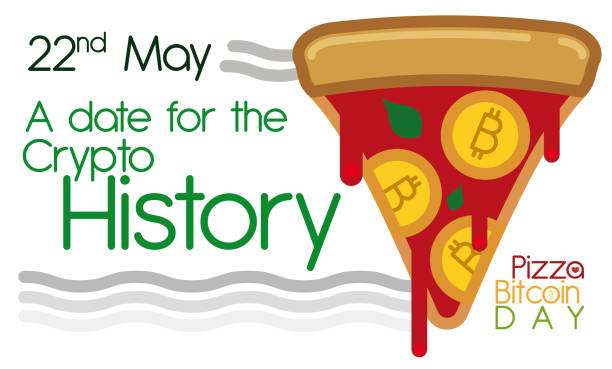
The first major purchase with bitcoin happened on May 22, 2010. Laszlo Hanyecz, a programmer who had been mining bitcoin since early 2010 and had built up tens of thousands of coins, posted on the BitcoinTalk forum offering 10,000 BTC for pizza. Another forum user accepted the offer, ordered two Papa John’s pizzas, and received the 10,000 BTC. At the time, those bitcoins were worth about $41. At Bitcoin’s highest price in late 2025, the same 10,000 BTC would have been worth more than $1 billion.
Bitcoin Pizza Day, celebrated every May 22, is often remembered as the day someone spent a fortune on pizza. The real story is what the purchase meant. It was the first time bitcoin was used to buy something in the real world. Bitcoin was no longer just an idea or a project for programmers. It had become something people could actually use as money.
Also in 2010, the first bitcoin exchanges appeared. Bitcoin Market launched in March. Mt. Gox followed in July and at first handled only a small number of trades each day. By the end of the year, bitcoin had its own exchange market and traded for about $0.30 per coin, up from almost nothing at the start of 2010.
Satoshi Walks Away
Satoshi Nakamoto made his last public posts in late 2010. In December, WikiLeaks announced it would accept bitcoin donations after Visa, Mastercard, and PayPal stopped processing its payments following the release of U.S. diplomatic cables. Satoshi warned that the attention could come too soon, writing that “it would be good to not make a high-profile target right now.” His final forum post came later that month. By April 2011, he had handed over the project to other developers and disappeared from public view. Nobody has heard from Satoshi since.
The First Boom, the First Crash, and Silk Road (2011–2013)
Bitcoin’s first major price rally came in 2011. It started the year at around $1 and climbed to $31 by June, a gain of more than 3,000 percent in just six months. The rally caught the attention of technology websites, early adopters, and people who discovered bitcoin through Silk Road, the online marketplace that launched in February 2011 and accepted only bitcoin as payment.
Silk Road became the first marketplace to use bitcoin on a large scale. It showed that people could use bitcoin to buy and sell goods without relying on banks or payment companies. At the same time, it gave bitcoin a reputation that would follow it for years. The marketplace was known for selling illegal drugs, fake documents, and other banned goods.
Most news coverage focused on the illegal activity. Bitcoin quickly became known as “drug money.” But the same features that attracted Silk Road also made Bitcoin useful for many legal purposes. Anyone could send money without asking permission, banks could not freeze accounts, and users could move money across borders with little friction.
The First Crash
The first boom did not last. After reaching $31 in June 2011, bitcoin fell to about $2 by the end of the year.
Part of the panic came after hackers breached Mt. Gox, the largest bitcoin exchange at the time, in June 2011. An attacker gained access to an administrator account and briefly crashed the market price to one cent, causing a wave of false trades and withdrawals. As detailed in our research on the history of crypto hacks, the incident was the first major warning that cryptocurrency exchanges could become prime targets for hackers.
Bitcoin continued to grow through 2012 and 2013. In November 2012, the network completed its first halving, reducing the block reward from 50 BTC to 25 BTC. Few people paid much attention at the time, but the strong price rally that followed helped create the belief that halvings would shape Bitcoin’s market cycles.
In the spring of 2013, the banking crisis in Cyprus gave Bitcoin another boost. As fears spread that bank deposits could be used to help pay for a government bailout, some people turned to Bitcoin as an alternative. The price climbed from about $13 to $266 before falling back to around $50.
By October 2013, the FBI had shut down Silk Road and arrested its alleged founder, Ross Ulbricht. Authorities also seized about 144,000 BTC. Many people expected bitcoin’s price to collapse. Instead, the case introduced bitcoin to millions of people around the world. Not all of the attention was positive, but it made bitcoin impossible to ignore.
On November 27, 2013, bitcoin crossed $1,000 for the first time. It soon reached a high of $1,242. It would not trade above that level again for more than three years.
Mt. Gox: The Collapse That Defined a Generation (2014)
February 2014
Mt. Gox collapses. 850,000 BTC, about 7% of all Bitcoin in existence, disappears.
The collapse of Mt. Gox is one of the most important events in Bitcoin’s history outside of Satoshi Nakamoto’s work. It exposed the risks of trusting a centralized custodian to hold a decentralized asset and gave rise to a principle that still defines Bitcoin security today: “Not your keys, not your coins.”
By February 2014, Mt. Gox processed roughly 70% of all Bitcoin trading worldwide. Mark Karpelès had been running the exchange since purchasing it from Jed McCaleb in 2011. Originally built as a trading platform for collectible game cards, Mt. Gox was never designed to secure hundreds of millions of dollars in digital assets, and its security practices failed to keep pace with its rapid growth.
The Collapse of Mt. Gox
On February 7, 2014, Mt. Gox suspended all Bitcoin withdrawals. Three weeks later, on February 28, the company filed for bankruptcy in Japan, revealing that approximately 750,000 customer BTC and 100,000 of its own BTC had vanished. The missing 850,000 BTC represented about 7% of all Bitcoin in circulation at the time. Bitcoin’s price fell roughly 36% in the following days and kept falling throughout the year, eventually reaching a low near $200 in January 2015.
Investigators later concluded that the exchange’s wallets had been drained gradually over several years. Weak accounting systems allowed the theft to go undetected by recording the missing coins as legitimate transfers. Karpelès was arrested in Japan in 2015 and was later convicted of falsifying financial records. US authorities also charged Russian nationals Alexey Bilyuchenko and Aleksandr Verner with laundering the stolen Bitcoin through BTC-e, another exchange that authorities shut down in 2017.
Creditors waited more than a decade to recover their funds. In July 2024, bankruptcy trustee Nobuaki Kobayashi began distributing approximately 142,000 BTC recovered from the estate. Although many feared the repayments would trigger heavy selling, the market absorbed the distributions with far less disruption than expected.
Mt. Gox permanently changed how Bitcoin users thought about custody. It convinced many that leaving coins on an exchange was very different from holding them yourself. Hardware wallets, self-custody practices, and the phrase “Not your keys, not your coins” all gained momentum after the collapse. Since then, every major exchange breach has been compared with Mt. Gox, the benchmark against which later incidents are measured. If you are interested in how exchange hacks have changed over the years, see our research on the history of crypto hacks.
The Long Recovery and the Infrastructure Years (2015–2016)
The two years after the Mt. Gox collapse were among the quietest in Bitcoin’s history. The price traded mostly between $200 and $400; trading volumes remained modest, and much of the mainstream attention from 2013 had faded. The people who stayed were those who believed in Bitcoin for more than its price. They included developers, long-term holders, and early companies building the infrastructure needed for wider adoption.
Those years laid the foundation for Bitcoin’s next chapter. Coin Center was founded in 2014 to advocate for cryptocurrency policy in Washington. In January 2015, Coinbase raised a $75 million Series C, the largest venture investment in a Bitcoin company at the time. The funding showed that major investors still believed in Bitcoin despite the collapse of Mt. Gox. Around the same time, Bitfinex, Kraken, and Bitstamp became the leading exchanges supporting the growing ecosystem.
The Second Halving and the Block Size Debate
The second Bitcoin halving took place in July 2016, reducing the block reward from 25 BTC to 12.5 BTC. Unlike the first halving, the event attracted widespread attention from the Bitcoin community. As explained in our research on the Bitcoin halving, the immediate price reaction was disappointing. Bitcoin fell by roughly 40% in the weeks that followed before beginning the rally that eventually peaked at $19,783 in December 2017.
Another major issue during this period was the block size debate. Bitcoin’s 1 MB block size limit restricted the number of transactions the network could process. As usage increased, the network became congested, and transaction fees rose.
One group believed the simplest solution was to increase the block size. Another argued that Bitcoin should keep small blocks and scale through second-layer technologies such as the Lightning Network. The disagreement lasted for years and divided the community. In August 2017, it ended with the activation of Segregated Witness (SegWit) and the creation of Bitcoin Cash (BCH), a new cryptocurrency launched through a hard fork for supporters of larger blocks.
The 2017 Mania: Bitcoin Becomes a Household Name
December 17, 2017
Bitcoin reaches $19,783. The world is watching.
The 2017 bull market was Bitcoin’s first moment of global attention. The price rose from about $1,000 in January to $19,783 in December, an increase of nearly 1,900% in twelve months. Bitcoin appeared on newspaper front pages, prime-time television, and dinner table conversations among people who had never shown much interest in financial markets. As discussed in our research on bull run psychology, this level of public attention is one of the signs that a market cycle may be approaching its peak.
The rally was driven by two overlapping trends. The first was retail FOMO, as millions of new investors opened accounts on Coinbase, Binance, and other exchanges after seeing Bitcoin’s price surge. The second was the ICO boom on Ethereum, which increased demand for Bitcoin because it served as the main way to buy newly issued tokens. As more money flowed into Bitcoin, interest spread to ICOs and Ethereum, generating even more media coverage and attracting another wave of investors.
The Peak and the Crash
In December 2017, the Chicago Mercantile Exchange launched Bitcoin futures, the first regulated Bitcoin derivatives product in the United States. At the time, many viewed the launch as another step toward institutional acceptance. Looking back, it also gave large investors an easier way to bet against Bitcoin, and the launch closely matched the market’s peak.
The correction that followed was severe. Bitcoin fell from $19,783 in December 2017 to $3,122 one year later, a decline of about 84%. Although prices reached their low by the end of 2018, market sentiment stayed weak throughout 2019 and into early 2020. Apart from a short-lived rally in April 2019, confidence in Bitcoin did not fully recover until the next bull market began.

Institutional Adoption Begins: MicroStrategy, Tesla, and the 2020 Cycle
August 11, 2020
MicroStrategy invests $250 million of its corporate treasury in Bitcoin. The institutional era begins.
The 2020 and 2021 bull market looked different from every previous Bitcoin cycle. The emotions followed a familiar pattern. As explained in our research on bull run psychology, investors moved through disbelief, hope, optimism, euphoria, and finally distribution. The biggest difference was who was buying Bitcoin.
On August 11, 2020, MicroStrategy, a publicly traded business intelligence company led by Michael Saylor, announced that it had purchased 21,454 BTC for $250 million. The company adopted Bitcoin as its primary treasury reserve asset, arguing that it offered better long-term protection than holding cash because of its fixed supply and resistance to inflation. Saylor soon became one of Bitcoin’s most outspoken supporters, encouraging other companies to adopt the same strategy.
MicroStrategy’s decision encouraged other public companies to follow. Tesla purchased $1.5 billion in Bitcoin in February 2021. Square, now known as Block, bought $50 million in October 2020. Marathon Digital, Riot Platforms, Galaxy Digital, and many other publicly traded companies also added Bitcoin to their balance sheets. Bitcoin was no longer viewed only as a speculative investment for retail traders. It was increasingly being considered a treasury asset by public companies.
A New Wave of Adoption
The global economic environment also helped fuel the rally. The COVID-19 pandemic led governments and central banks to introduce large stimulus programs and historically high levels of monetary support. Asset prices rose across many markets, and Bitcoin was among the biggest beneficiaries. Its price climbed from $8,727 at the May 2020 halving to $69,000 in November 2021.
Several factors contributed to the rally. The halving reduced the rate of new Bitcoin entering circulation. Corporate treasury purchases and growing hedge fund participation increased demand. At the same time, millions of retail investors entered the market through easy-to-use mobile investing apps, helped in some countries by government stimulus payments.
$8,727
Bitcoin price at the May 2020 halving
$69,000
Bitcoin’s all-time high—November 10, 2021
In September 2021, El Salvador became the first country to adopt Bitcoin as legal tender. President Nayib Bukele’s government gave every citizen $30 worth of Bitcoin through a government wallet called Chivo. The decision drew worldwide attention and criticism from organizations such as the IMF and the World Bank. It also became the first large-scale test of Bitcoin as legal tender.
The results were mixed. Adoption fell short of government expectations, the Chivo wallet experienced technical problems, and Bitcoin’s price decline reduced the value of the country’s holdings. In 2024, El Salvador reached an agreement with the IMF that inc
The 2022 Collapse: FTX and Crypto Winter
November 2022
FTX collapses. Bitcoin falls to $15,500. The worst is not over.
Bitcoin’s decline began in early 2022 after reaching a record high in November 2021. Rising interest rates, high inflation, and tighter monetary policy pushed investors away from riskier assets, including cryptocurrencies. By June 2022, Bitcoin had fallen below $20,000, wiping out all of the gains from the 2020 and 2021 bull market.
The downturn accelerated after the collapse of the Terra ecosystem in May 2022. The failure of TerraUSD (UST) and LUNA triggered a chain reaction across the crypto industry, contributing to the failures of Three Arrows Capital, Celsius, Voyager Digital, and BlockFi.
The Fall of FTX
The crisis reached its peak in November 2022 with the collapse of FTX. Sam Bankman-Fried founded FTX, and it grew into the world’s second-largest cryptocurrency exchange. Investors valued the company at $32 billion earlier that year. Leading venture capital firms backed FTX, and many people considered it one of the industry’s most successful companies.
That image changed after investigators revealed that FTX had used customer funds to support its affiliated trading firm, Alameda Research. On November 6, Binance announced it would sell its holdings of FTT, FTX’s native token, triggering a wave of customer withdrawals. Within days, FTX halted withdrawals and filed for bankruptcy on November 11. The company could not account for about $8 billion in customer funds.
Authorities arrested Sam Bankman-Fried in December 2022 and extradited him to the United States. A jury convicted him in November 2023 on multiple counts of fraud and conspiracy. In March 2024, a judge sentenced him to 25 years in prison.
Bitcoin fell to around $15,500 after the collapse. Confidence across the crypto market reached one of its lowest points. Only months earlier, many people had viewed companies such as Three Arrows Capital, Celsius, Voyager Digital, and FTX as symbols of the industry’s growth. Their failures raised fresh questions about risk, regulation, and trust.
The recovery began in January 2023. As in previous cycles, it started long before confidence returned.
The ETF Approval and the New Era (2023–2024)
The story of Bitcoin’s recovery from the 2022 lows and its path into the 2024 and 2025 cycle comes down to one event: the approval of spot Bitcoin ETFs in the United States on January 10, 2024. As explained in our research on Bitcoin ETFs, the approval followed eleven years of applications, seven rejections, and a federal court ruling that said the SEC had treated similar products inconsistently.
Spot Bitcoin ETFs
BlackRock submitted its application in June 2023. As the world’s largest asset manager, with more than $10 trillion under management, its application convinced many investors that approval had become much more realistic. Fidelity, ARK, Invesco, and several other firms filed applications shortly afterward. After losing its court case against Grayscale in August 2023, the SEC approved eleven spot Bitcoin ETFs on January 10, 2024.
The market responded immediately. BlackRock’s iShares Bitcoin Trust (IBIT) reached $10 billion in assets after just 49 trading days, the fastest ETF to reach that milestone. By the fourth Bitcoin halving in April 2024, spot Bitcoin ETFs were attracting average daily inflows of about $208 million. At Bitcoin’s price of around $60,000, those inflows equaled almost four times the value of the new Bitcoin miners produced each day.
Bitcoin reached a new all-time high before the April 2024 halving, something that had never happened in previous market cycles. As explained in our research on the Bitcoin halving, demand from spot Bitcoin ETFs pushed prices higher before the reduction in new supply took effect. As a result, the gains after the halving were smaller than in earlier cycles.
Bitcoin climbed to about $126,000 in October 2025, setting its current all-time high, before falling back to the $75,000 range by July 2026. At its peak, Bitcoin’s market capitalization exceeded $2.5 trillion, making it temporarily more valuable than several of the world’s largest publicly traded companies.
$58.72B
Cumulative net inflows into US spot Bitcoin ETFs since January 2024
Bitcoin ETFs absorbed more capital in their first eighteen months than gold ETFs did in their first several years. BlackRock’s IBIT alone has accumulated over $60 billion in assets, making it one of the fastest-growing ETF products in financial history. The ETF approval permanently changed who participates in Bitcoin markets and how institutional capital accesses the asset.
Bitcoin’s Technical Development
Bitcoin’s price history receives most of the attention, but the network itself has also improved since 2009.
Segregated Witness (SegWit), activated in August 2017, increased Bitcoin’s effective block capacity by separating signature data from transaction data. This allowed more transactions to fit into each block without increasing the 1 MB block size limit. It also fixed a long-standing issue that had made it harder to build second-layer technologies. SegWit ended the block size debate on Bitcoin’s main network and made the Lightning Network possible.
Scaling, Privacy, and New Features
The Lightning Network launched in 2018 and has continued to grow. It enables fast, low-cost Bitcoin payments by allowing users to transact through payment channels before settling the final balance on the Bitcoin blockchain. According to River Financial, Lightning processed more than $1 billion in monthly payment volume during 2025, while merchant adoption of Bitcoin payments increased by 74%. Lightning has made Bitcoin more useful for everyday payments, although its use is still small compared with traditional payment networks.
The Taproot upgrade, activated in November 2021, improved Bitcoin’s privacy, efficiency, and scripting capabilities by introducing Schnorr signatures. These signatures allow multiple approvals to be combined into a single signature, reducing transaction size and making complex multi-signature transactions look similar to ordinary transactions on the blockchain. Taproot also expanded Bitcoin’s scripting capabilities, although it stopped well short of the fully programmable smart contracts found on Ethereum.
Ordinals and Bitcoin NFTs
The Ordinals protocol launched in January 2023 and used Taproot’s additional data capacity to store images, text, and other data directly on individual satoshis. This made Bitcoin NFTs and the BRC-20 token standard possible. The idea divided the Bitcoin community. Some argued that using block space for digital collectibles conflicted with Bitcoin’s purpose as a monetary network, while others believed that anyone willing to pay transaction fees should be free to use block space as they wished. One result was a sharp increase in transaction fees, showing that fees could become a more important source of revenue for miners as block rewards continue to decline.
The possibility of quantum computers breaking Bitcoin’s cryptography has also become a topic of discussion. As explained in our research on Bitcoin’s quantum resistance, Bitcoin’s ECDSA signature scheme could become vulnerable if sufficiently powerful quantum computers are built. BIP-360 and BIP-361 propose new quantum-resistant address types, but neither proposal has gained enough support for activation. Bitcoin’s governance process requires broad agreement from developers, miners, node operators, and the wider community, making protocol upgrades slower than on many other blockchains, including Ethereum.
Bitcoin in 2026: What It Is and What It Isn’t
Bitcoin in July 2026 is a $1.3 trillion asset trading near $75,000 per coin. It is about 17 years old. During that time, it has survived the collapse of its largest exchange, several price declines of more than 80%, the disappearance of its creator, government bans in major economies, and the launch of thousands of competing cryptocurrencies. Yet none has replaced it as the leading store of value in the crypto market.
What Bitcoin is today differs from what Satoshi Nakamoto described in the 2008 whitepaper. He introduced it as “a peer-to-peer electronic cash system,” designed for online payments without financial intermediaries. In practice, Bitcoin is no longer used mainly for everyday purchases. High on-chain transaction fees, price volatility, and the challenges of self-custody have limited its role as a day-to-day payment method. El Salvador’s experience also showed that widespread daily use is difficult when prices can change significantly in a short period.
Bitcoin as Digital Gold
Instead, Bitcoin has become what many investors describe as digital gold. Its fixed supply of 21 million coins, predictable issuance schedule, secure blockchain, and decentralized network have made it the leading non-sovereign store of value. Whether those qualities justify a market capitalization of $1.3 trillion, its previous peak of $2.5 trillion, or a different valuation altogether is something investors continue to debate.
Corporate adoption has also expanded since MicroStrategy made its first purchase in 2020. By mid-2026, Strategy (formerly MicroStrategy) held more than 500,000 BTC, making it the world’s largest corporate Bitcoin holder. Many other publicly traded companies have added Bitcoin to their balance sheets, although in much smaller amounts. Several sovereign wealth funds have also gained exposure through spot Bitcoin ETFs. What began as an idea shared among cryptographers has become an investment that companies, governments, and institutional investors now consider alongside more traditional assets.
$75K
Bitcoin price — July 2026
$1.3T
Bitcoin market capitalization — July 2026
The Satoshi Question
Any complete history of Bitcoin has to address the Satoshi question. Not because it can be answered here, but because the mystery itself has become part of the network’s story.
About 1 million BTC sit in wallets widely believed to belong to Satoshi Nakamoto. These coins were mined during the network’s earliest days, when Satoshi was the primary, and possibly the only, miner. At July 2026 prices, they are worth about $75 billion. They have never moved. Not a single Satoshi has left the addresses most closely linked to Satoshi’s mining activity in 2009 and early 2010.
Why Haven’t the Coins Moved?
People interpret the unmoved coins in different ways. Some believe Satoshi is dead and that the private keys have been lost forever. Others believe Satoshi made a deliberate decision never to spend the coins, arguing that moving such a large amount could disrupt the market and weaken the idea of a decentralized system with no central figure in control. A smaller group believes Satoshi is waiting for the right moment, although no one has explained what that moment might be.
Whatever the explanation, the coins remain one of the biggest unanswered questions in cryptocurrency. If Satoshi is still alive and controls the private keys, those 1 million BTC could, in theory, enter the market one day. If quantum computing ever becomes powerful enough to break ECDSA, the wallets holding those coins, along with other wallets that have exposed public keys, could become vulnerable. More than seventeen years after the network launched, Satoshi’s coins remain both a link to its past and a source of questions about its future.
What I’m Watching
The history of Bitcoin is a history of surviving events that many believed would end it. Government bans, exchange failures, regulatory crackdowns, price declines of more than 80%, and competing cryptocurrencies have all tested the network. Yet it continues to attract new users, investors, and developers who see value in a digital asset with a fixed supply.
The Questions Ahead
The on-chain metrics I watch most closely are long-term holder behavior alongside ETF flows, a combination discussed in our research on bull run psychology, and miner economics alongside the network’s hash rate. When long-term holders accumulate while ETF flows are negative, it has historically provided an early indication that the market may be approaching a bottom. When both groups are selling at the same time, history has generally pointed in the opposite direction.
Another long-term question is the development of the transaction fee market. Every halving reduces the block subsidy paid to miners, making transaction fees more important over time. The Ordinals experiment showed that fees can become a meaningful source of miner revenue. Whether a lasting fee market develops through genuine demand for block space instead of periodic demand for NFTs or memecoins will play an important role in the network’s long-term security.
The fifth halving is about twenty-one months away. The block reward will fall to 1.5625 BTC. The spot Bitcoin ETF market will still exist, corporate treasury holders are expected to remain in place, and the question of quantum resistance will move closer to requiring an answer. By then, the network will be eighteen years old, and nobody will know who created it.
That may be the most enduring part of Bitcoin’s story. Someone whose identity remains unknown created a system, disappeared in 2011, and left behind a network that has operated as designed for more than seventeen years without its creator. More than the price, the halvings, or the ETFs, what sets Bitcoin apart is that it has operated without a central authority from the very beginning.
Key Takeaways
Bitcoin’s Early Years
Bitcoin’s whitepaper was published on October 31, 2008, six weeks after the Lehman Brothers bankruptcy, by an unknown person or group using the pseudonym Satoshi Nakamoto. The genesis block was mined on January 3, 2009, with a newspaper headline about a bank bailout included in its data. Satoshi’s identity has never been established.
Bitcoin received its first widely recognized market price in 2010, when Laszlo Hanyecz paid 10,000 BTC for two pizzas. At Bitcoin’s October 2025 peak, those coins would have been worth about $1.26 billion. The purchase is remembered each year as Bitcoin Pizza Day on May 22.
The Mt. Gox collapse in February 2014 led to the loss of about 850,000 BTC, roughly 7% of the supply at the time. It popularized the principle, “Not your keys, not your coins.” Creditors waited more than a decade before repayments began in July 2024.
Institutional Adoption
The 2020-2021 cycle marked the first period of sustained institutional participation. MicroStrategy’s treasury strategy in August 2020, followed by Tesla, Square, and other public companies, introduced a new group of long-term holders with investment timeframes that differed from earlier retail-driven cycles.
The approval of spot Bitcoin ETFs on January 10, 2024, marked another turning point. Cumulative net inflows have exceeded $58.72 billion, and average daily inflows during February 2024 reached about $208 million, almost four times the value of newly mined Bitcoin each day. For the first time, Bitcoin reached a new all-time high before a halving, showing how institutional demand influenced the market ahead of the supply reduction.
An Unanswered Mystery
Wallets widely believed to belong to Satoshi Nakamoto still hold approximately 1 million BTC, and none of those coins has ever moved. At July 2026 prices, they are worth about $75 billion. Whether those coins will ever move is still one of the biggest unanswered questions in Bitcoin’s history.
Sources & Further Reading
- Bitcoin: A Peer-to-Peer Electronic Cash System — Satoshi Nakamoto (2008)
- Ledger Academy: When Was Bitcoin Invented? The Complete History and Timeline
- Bitcoin.com: Bitcoin Revolution: History, Origins and Where We Are in 2026
- DaveManuel.com: Bitcoin Price History: From $0.0008 to $126,000
- Capital.com: Bitcoin Price History 2009–2026: Key Milestones
- CoinTracker: Bitcoin Price History: Key Events That Shaped BTC
- StealthEX: Bitcoin Price History Chart: ATH, Halving and Timeline (2009–2026)
- Bitget: Bitcoin History Timeline: Complete Guide from 2008–2026
- MEXC: The Complete History of Bitcoin: When Did Bitcoin Start
- CCN: Bitcoin Price History Insights: 2009–2024
- CoinCodex: Bitcoin Turns 10: The Tenth Anniversary of the Genesis Block
- The Blockchain History: Bitcoin History: Complete Evolution from 2008 to 2025
- Bit Gold — Nick Szabo (1998),
- Nakamoto Instituteb-money — Wei Dai (1998)